
Why your room makes your songs sound boomy
Hello again, and welcome back to Kitchen Table Recording, the column where we fix one everyday recording problem with whatever is already lying around the house. This time the problem is the room itself. You play a song, you listen back, and the low end has turned to porridge. The bass notes hum, your foot tapping on the floor thuds like someone knocking downstairs, and your voice sounds as if it's coming from inside a wardrobe.
Before you buy anything or staple a single blanket to the wall, it helps to know which problem you actually have. Rooms cause two different kinds of trouble. Reflections are the quick bounces off hard surfaces: the ring, the flutter, that tiled-bathroom sound. Boom is the low end piling up and smearing everything into mud. Blankets, books and curtains are fairly good at the first and fairly weak at the second. That's exactly why it pays to test before and after every change instead of guessing.
Two tests you can do tonight: the clap and the replay
Start with your hands. Sit or stand where you usually play and clap once, sharp and loud. Then listen to what the room does after your hands have stopped. A sharp ringing or metallic flutter, like a little spring going zing, suggests parallel hard surfaces, often opposite walls or a bare floor and ceiling. Try it in a couple of spots and make a note of where the ring is worst, because that's where something soft is most worth a try.
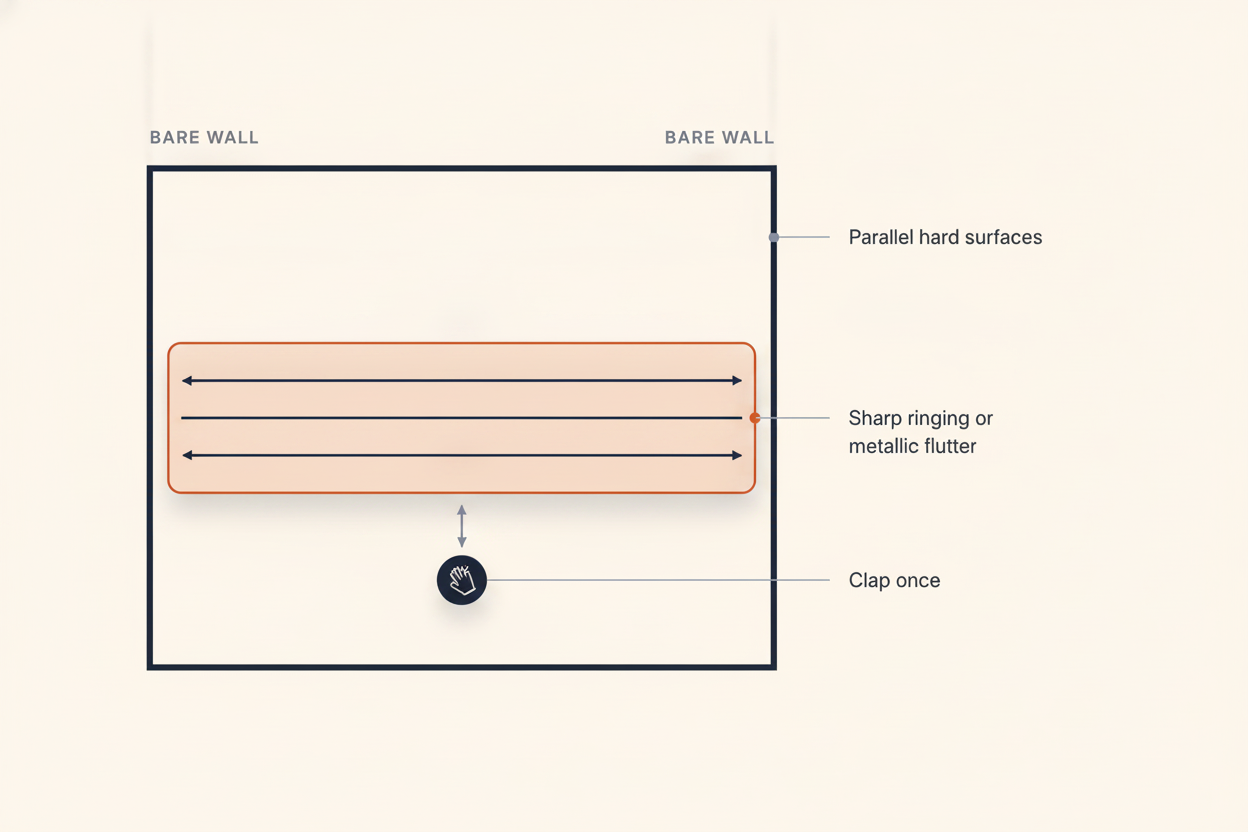
The clap is good at finding flutter, but boom lives in the low notes of your actual music, so the second test uses your song. Record a short before-and-after pair: the same bit of playing, with one change to the room between takes. Then listen to both, back to back. Boom shows up as thick, muddy low notes. Reflections show up as a hollow, roomy halo around your voice and instrument.
Your before-and-after listening check
- Pick 20 to 30 seconds of your song that includes your lowest notes and your voice.
- Record with the same device, in the same spot, at the same volume each time.
- Clap once at the start of every take, so each file has the room's ring on it too.
- Change only one thing between takes.
- Name each file after the change, like "before" or "blanket on rack behind chair".
- Listen back on the same headphones or speakers, at the same volume.
One more thing to try while you're listening: move yourself. Sitting against the back wall usually puts you in a strong bass buildup zone, and pulling your chair forward even 12 to 24 inches can help. Play your "before" file from your usual seat, then again from a spot a little further into the room. If the low end tightens up just from moving the chair, you've learned something about your room without spending a penny.
What blankets, books and curtains really change
Here's the honest part. Bass has very long wavelengths: a 100 Hz tone is about 11 feet long, and a quarter-inch blanket flat on a wall barely touches it. Thin fabric pressed against a wall does very little for the mid and low frequencies that make a room sound boomy or muddy, so treat blankets as a stopgap, not a fix. What a heavy moving blanket or thick curtain does well is soak up some of the high-frequency echo, which is why one hung behind a microphone can make a voice recording sound less roomy. Audiosilk's beginner guide sums up DIY moving blankets nicely: not perfect, but better than nothing for temporary treatment.
If you use them, give them an air gap. A blanket draped a few inches off the wall, or hung on a stand, absorbs more than one stapled flat against it. A clothes-drying rack makes a handy stand, and it folds away when the in-laws visit.
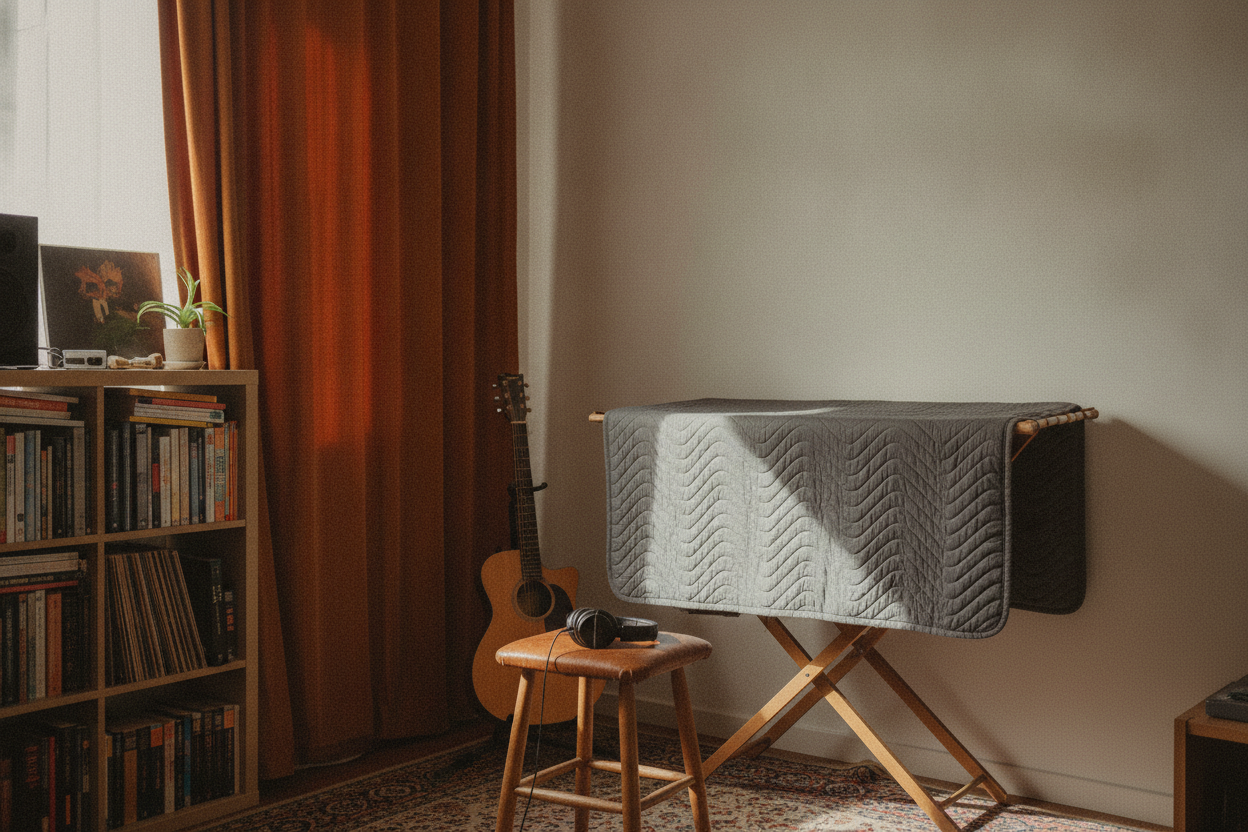
Curtains are where the advice splits. Thick curtains and a heavy rug can absorb excess low frequencies as a quick fix for bass boom, according to Beam and Bass. On the other hand, heavy pleated velour curtains do more than thin decorative ones, but both work mainly on the high frequencies, according to Acoustic Sound Panels. Your before-and-after files are the referee here. If you have a bare window, swapping thin blinds for heavy, dense curtains in velvet, thick cotton or layered fabric is a sensible step for window reflections either way. Skip curtains sold as soundproof or blackout for this job: they may cut a little outside noise coming through a window, but they don't stop echo inside the room in any meaningful way.
On a hard floor, a thick rug with a good pad underneath can tame the bounce off the floor. Eureka Ergonomic's rule of thumb for a noticeable difference is covering at least 60% of the open floor between your desk and the opposite wall, so a little doormat under your chair is a start rather than the whole answer.
Books might be the most cheerful fix of the lot if you already own a pile of them. A well-filled bookshelf makes a decent diffuser, which means it scatters sound in lots of directions instead of bouncing it straight back at you. How you fill it matters. A flat wall of books all the same depth can still act like a reflective surface, while an irregularly filled shelf, with books of different depths, a few gaps and the odd object tucked in, is a much better scatterer. Finally, a reason to stop tidying.
Keep expectations sensible. A filled bookshelf, a sofa or armchair, curtains and thick wall art can all reduce some reflections, but they aren't precision acoustic products. The same goes for those thin egg-crate foam tiles: they can absorb some high-frequency flutter, yet do almost nothing for the mid and low-frequency buildup that makes a room boomy. If your clap goes zing, all of these help. If your replay sounds like mud, they mostly won't.
When the boom won't budge
If your low end is still woolly after the blankets, books and rug, nothing has gone wrong; you've just found the limit of soft furnishings. Boom needs depth. For bass traps, look for products built from dense mineral wool or fiberglass, ideally at least 4 inches thick. Acoustic panels also like a little breathing room: an air gap of about 1 to 2 inches behind a panel, instead of mounting it flush against the wall, boosts its performance. As a price reference, Acoustic Sound Panels' 24 x 24 inch panels start at $39.99, so you can add a couple, run your replay test, and add more only if your ears say so.
When you compare panels, you'll see a number called NRC, short for Noise Reduction Coefficient. It averages how much a material absorbs at 250, 500, 1000 and 2000 Hz, so it doesn't measure bass at all. A high NRC tells you a panel handles the middle and upper sounds; for boom, thickness is the better clue.
How much should you cover? Treating about 40 to 60% of your wall surface gives most rooms a good balance without making them sound unnaturally dead, as Audiosilk's guide suggests. And if you listen back on speakers with an opening in the back (rear-ported speakers), they often get boomy when pushed close to a wall; about 18 to 36 inches of clearance is a good starting point when the room allows it.
Check the fire rating
Many moving blankets aren't fire rated, so check before hanging them in a business or public space, like a shop, a church hall or a rehearsal room you rent. Fabric-wrapped panels going into a living space should be rated for fire safety and mounted securely.
Keep your "before" file
One limit before you start rearranging the house: none of this keeps your playing from reaching the neighbors, or the neighbors' leaf blower from reaching your recording. Blankets, curtains and panels work on the sound inside the room. Stopping sound getting in or out takes construction, such as added mass, sealed gaps and decoupled walls, which is a much bigger job than this column.
Whatever you try, hang on to that very first "before" recording. Every change after it is one clap and one replay away from an honest answer, and a folder of labeled takes tells you more about your room than any shopping list. If the clap still goes zing after all that, you've found your next free fix: one more soft, lumpy thing on that bare wall.
From the series Kitchen Table Recording
Sources
- How to Treat Room Acoustics Without Overspending – AudioReputation – audioreputation.com
- Do Moving Blankets or Curtains Work as Acoustic Panels? | Acoustic Sound Panels – acousticsoundpanels.com
- The Complete Beginner's Guide to Home Studio Acoustic Treatment – AudioSilk – audiosilk.com
- Boomy Bass? The 3 Room Problems That Cause It – BeamAndBass – beamandbass.com
- Reduce Home Office Echo | DIY Acoustic Solutions for Clearer Calls – eurekaergonomic.com